Higher Order Filters
From the discussion made so far on the
filters, it may be concluded that in the stopband the gain of the filter
changes at the rate of 20 db/decade for first-order filters and 40
db/decade for second-order filters. This means that as the order of the
filter is increased, the actual stopband response of the filter
approaches its ideal stopband characteristics. In general, a third-order
filter produces 60 db/decade, a fourth-order filter produces 80
db/decade and so on.
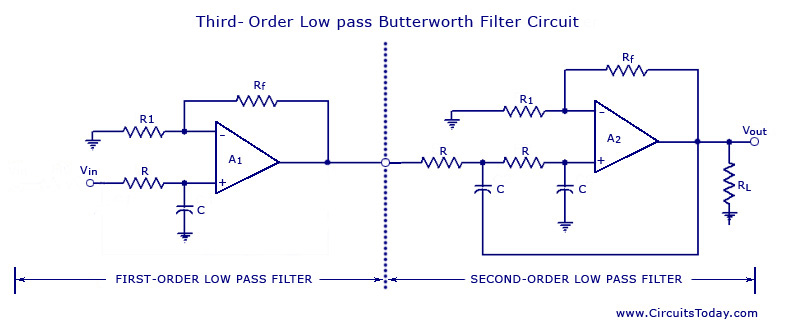
Higher-order filters, such as third, fourth, fifth, and so on, are built simply by using the first and second-order filters.
The simplest way to build a third-order
low-pass filter is by cascading a first order filter with a
second-order. Similarly a fourth-order low-pass filter can be formed by
cascading two second-order low-pass filters. Although there is no limit
to the order of the filter that can be formed, as the order of the
filter increases, so does its size. Also the accuracy declines, in that
the difference between the actual stopband response and the theoretical
stopband response increases with an increase in the order of the
filter.